TL;DR
- SIC (Standard Industrial Classification) is a 4-digit system created in 1937; NAICS (North American Industry Classification System) is a 2–6 digit system introduced in 1997.
- The U.S. federal government replaced SIC with NAICS for official statistics in 1997, but SIC is still widely used — particularly by the SEC, private databases, and B2B marketing tools.
- NAICS covers the U.S., Canada, and Mexico under one unified framework; SIC was U.S.-only (though the UK has its own parallel SIC system).
- NAICS has 20 sectors vs. SIC's 11 divisions — with significantly better coverage of modern service industries, technology, and information sectors.
- Both codes appear regularly in B2B company data and are used to filter, segment, and target companies by industry.
- Need to bridge North American and European classification systems? Use the InfobelPRO NACE to SIC converter to map codes in seconds.
If you work with business data in the United States, you have almost certainly encountered two industry classification systems: SIC and NAICS. Both assign standardized codes to companies based on their primary economic activity, making it possible to segment markets, conduct statistical research, and build targeted prospect lists. But they were created in different eras, follow different structures, and serve somewhat different audiences today.
This guide explains what SIC and NAICS codes are, how they differ, where each is used, and how B2B teams can work with both systems effectively.
What Are SIC and NAICS Codes?
SIC codes — Standard Industrial Classification codes — are a four-digit numerical system that groups companies according to their primary industry or economic activity. Created in the United States in 1937, the SIC system assigns every major economic sector a numeric range. The first digit identifies the broad division (for example, 2000–3999 covers manufacturing), and each subsequent digit narrows the classification to a specific industry group and sub-sector.
For a detailed breakdown of how the SIC system works — including the UK variant, the extended 8-digit format, and how to read each digit — see our SIC code definition and history guide. If you want the parallel guide for NAICS, What is a NAICS code? covers structure, hierarchy, and where each level applies.
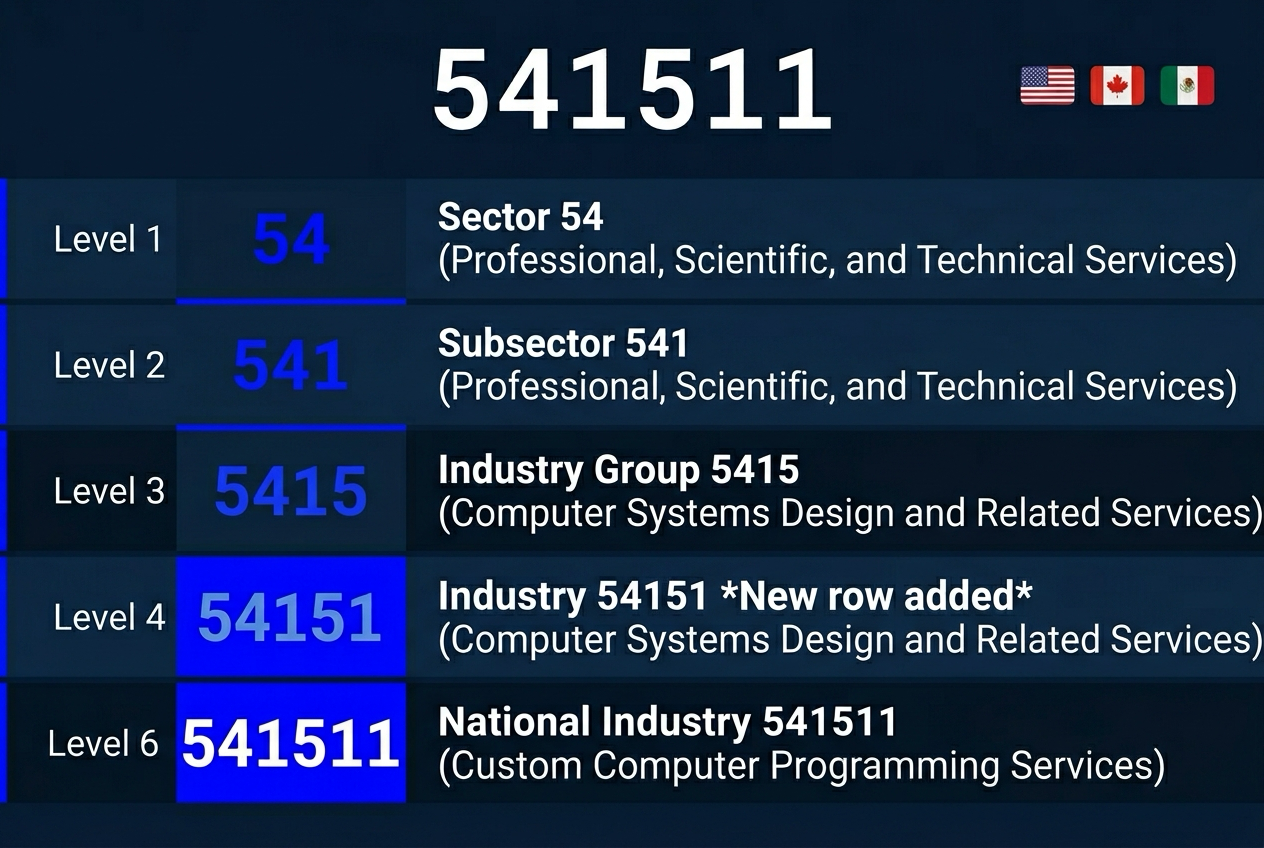
NAICS codes — the North American Industry Classification System — were introduced in 1997 to replace SIC as the standard for U.S. federal statistical reporting. NAICS was developed jointly by the statistical agencies of the United States, Canada, and Mexico to create a single, unified classification framework across all three North American economies. Its codes range from two to six digits, with each additional digit providing progressively finer classification.
SIC vs NAICS at a Glance
| SIC | NAICS | |
|---|---|---|
| Origin | United States, 1937 | USA, Canada, Mexico, 1997 |
| Code format | 4 digits (up to 8 with private extensions) | 2–6 digits |
| Industries covered | ~1,000 | 1,057 |
| Top-level sectors | 11 major divisions | 20 sectors |
| Geographic scope | USA (+ separate UK system) | North America (USA, Canada, Mexico) |
| Current federal use | Phased out for official U.S. statistics | Standard for all U.S. federal agencies |
| Still actively used? | Yes — SEC filings, commercial databases, B2B marketing | Yes — federal reporting, procurement, B2B databases |
Origin
SIC
United States, 1937
NAICS
USA, Canada, Mexico, 1997
Code format
SIC
4 digits (up to 8 with private extensions)
NAICS
2–6 digits
Industries covered
SIC
~1,000
NAICS
1,057
Top-level sectors
SIC
11 major divisions
NAICS
20 sectors
Geographic scope
SIC
USA (+ separate UK system)
NAICS
North America (USA, Canada, Mexico)
Current federal use
SIC
Phased out for official U.S. statistics
NAICS
Standard for all U.S. federal agencies
Still actively used?
SIC
Yes — SEC filings, commercial databases, B2B marketing
NAICS
Yes — federal reporting, procurement, B2B databases
What Is the Difference Between a SIC and a NAICS Code?
Although SIC and NAICS codes serve the same core purpose, they differ meaningfully in structure, scope, industry coverage, and where they appear in practice today.
Code structure and granularity
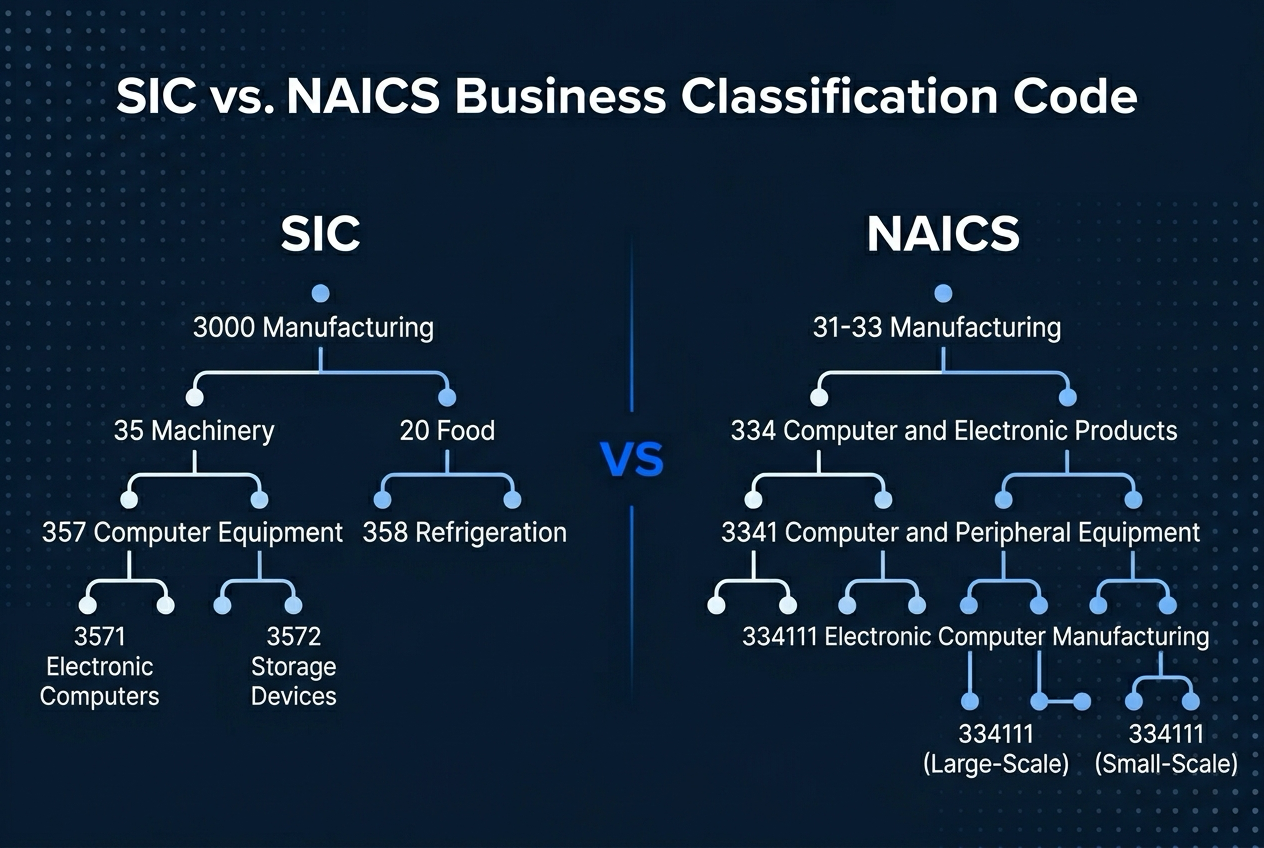
SIC uses a fixed four-digit hierarchy. Because it allows for only around 9,999 possible codes, many modern industries — particularly in technology, software, and information services — do not map cleanly onto SIC categories. Fast-growing sectors were often lumped into catch-all codes or residual categories that no longer reflect the diversity of today's business landscape.
NAICS addresses this with a six-digit hierarchy that accommodates over 1,000 distinct industry categories. It was designed specifically to capture the rise of service industries and digital businesses, introducing dedicated categories for sectors that barely existed in 1937.
Geographic coverage
SIC was created for the United States. The United Kingdom introduced its own parallel SIC system in 1948, but the two national versions have diverged over time and are not directly interchangeable. NAICS, by contrast, was built as a trilateral standard from day one — a company classified under a given NAICS code can be compared directly to its Canadian and Mexican counterparts in the same industry, which is especially valuable for trade analysis and cross-border prospecting.
Sector breakdown
SIC divides the entire economy into 11 major divisions. NAICS expands this to 20 sectors. The additional sectors reflect the fundamental economic shifts of the late 20th century: NAICS introduced dedicated categories for information technology, professional and scientific services, healthcare, and educational services — sectors that were either poorly represented in SIC or bundled together under broader headings.
Regulatory and commercial use today
NAICS is the official standard for U.S. federal agencies including the Census Bureau, Bureau of Labor Statistics, and IRS. It is also required for government procurement registrations. But SIC has not disappeared. The U.S. Securities and Exchange Commission (SEC) still classifies all publicly traded companies by SIC code on EDGAR. Many B2B databases, CRM platforms, and commercial data providers carry both codes, meaning that sales and marketing teams regularly encounter SIC alongside NAICS — and need to know which to use for a given task.
How Are SIC and NAICS Codes Used Today?
Federal statistics and government reporting
U.S. federal agencies use NAICS as their primary standard. The Census Bureau's Economic Census, the Bureau of Labor Statistics' employment data, and IRS industry statistics all rely on NAICS codes. Businesses registering in the System for Award Management (SAM.gov) for federal contracting are required to identify their primary activity using a NAICS code.
Securities and financial compliance
The SEC continues to use SIC codes to classify companies that file with it. Every publicly traded company's EDGAR filings include a SIC code identifying its primary business. This makes SIC directly relevant to financial analysts, compliance teams, and anyone working with capital markets data.
B2B prospecting and marketing
Both systems appear regularly in B2B company databases and CRM records. When building a target list of companies in a specific sector, marketers and sales teams typically filter by SIC, NAICS, or both. NAICS codes are particularly useful for matching against government procurement databases and North American cross-border campaigns; SIC codes offer more granularity through extended-digit private-sector databases and remain the reference point in older commercial datasets.
If you work with companies in the European Union, the equivalent classification system is NACE codes — the EU's statistical classification of economic activities. NACE and SIC share similar structural principles, and conversion tools exist to map between them when prospecting across both markets.
KYB and compliance verification
Industry classification codes also play a supporting role in Know Your Business (KYB) processes. Compliance teams use SIC and NAICS codes to cross-reference a company's declared sector against official registry data, assess industry-specific risk profiles, and flag classification discrepancies during onboarding workflows.
The History of SIC and NAICS Codes
SIC: a New Deal-era solution (1937)
The Standard Industrial Classification system emerged in 1937 during the Roosevelt administration. Federal agencies at the time each maintained their own definitions of "industry," making it nearly impossible to compare economic data across departments. The SIC system gave every agency a shared vocabulary: a four-digit code that uniquely identified each industry sector and could be applied consistently across employment surveys, trade statistics, and output reports.
The system was revised several times — most significantly in 1972 and 1987 — but its fundamental four-digit structure and 11-division framework remained intact for six decades. The United Kingdom introduced a parallel SIC system in 1948, revising it in 1992 and again in 2007 to align with the European NACE classification standard.
NAICS: the NAFTA-era overhaul (1997)
By the mid-1990s, the SIC system's limitations had become increasingly apparent. It struggled to classify the rapidly expanding service sector, poorly represented emerging technology industries, and provided no common standard across U.S., Canadian, and Mexican data — a critical gap as NAFTA created deep economic integration across North America.
In 1997, the statistical agencies of the three NAFTA countries — the U.S. Census Bureau, Statistics Canada, and Mexico's INEGI — jointly published NAICS as a replacement. The system was also designed to be compatible with the United Nations' International Standard Industrial Classification (ISIC), making North American data easier to compare with global economic statistics.
Unlike SIC, which was revised infrequently and eventually stagnated, NAICS follows a five-year revision cycle aligned with the U.S. Economic Census — 2002, 2007, 2012, 2017, and 2022 — ensuring that new industries and business models are incorporated on a regular schedule.
How to Obtain a SIC Code or NAICS Code
Finding your NAICS code
The U.S. Census Bureau maintains the official NAICS code manual and a searchable online index. You can also Browse NAICS codes by sector — every subsector, industry group, and 5-digit industry — in the InfobelPRO NAICS Code Database, which lets you search by code or keyword across 17.7 million classified US entities. To work the other side of the comparison, Browse SIC codes by industry covers the full SIC 1987 hierarchy from divisions to 4-digit industries.
When registering for federal contracts through SAM.gov, you will be required to enter at least one primary NAICS code. Businesses can also list secondary NAICS codes to reflect additional activities, though only one may be designated as primary.
Finding your SIC code
No single authority assigns SIC codes to private companies in the U.S. today. The most commonly used resources are:
- The OSHA SIC manual, which provides a searchable index of all original SIC codes and their descriptions.
- The SEC's EDGAR system, which assigns SIC codes to publicly traded companies based on their primary disclosed business activity.
- Commercial data providers, which include SIC codes in company records derived from government filings, business registries, and industry self-reporting.
In the United Kingdom, Companies House assigns SIC codes at incorporation. UK companies are required to provide at least one SIC code when registering or filing their annual confirmation statement.
Converting between classification systems
If your work requires mapping between North American SIC codes and European NACE codes — for example, when prospecting across Atlantic markets — the InfobelPRO NACE/SIC code converter lets you find equivalent codes across both systems instantly, without manual lookups. For the US-only direction, the SIC to NAICS crosswalk pairs 941 SIC 1987 industries with NAICS 2022 at the five-digit industry level, and states which SIC codes it does not cover.
SIC vs NAICS for B2B Marketing and Prospecting
For sales and marketing teams, the practical question is less about which system is "correct" and more about which one your data source uses — and how to filter effectively within it.
Use NAICS when:
- Targeting companies by federal procurement activity or government contract eligibility
- Building North American prospect lists that span the U.S., Canada, and Mexico
- Sizing markets using Census Bureau or Bureau of Labor Statistics data
- Aligning outbound campaigns with current standardized industry benchmarks
Use SIC when:
- Filtering against SEC filings, financial databases, or EDGAR-linked records
- Working with legacy CRM data or older commercial datasets that pre-date 1997
- Leveraging extended SIC codes (6- or 8-digit) for sub-industry granularity that NAICS does not provide
Use both when:
- Your data vendor provides both fields, allowing cross-reference for maximum coverage
- You are running campaigns across multiple sources that each default to a different system
- You want to validate industry classifications across internal and external datasets to ensure consistency
InfobelPRO's firmographic data with NAICS codes carries SIC, NAICS, and NACE on every record, making it straightforward to build targeted prospecting lists across North American and European markets without switching between separate classification systems.
Conclusion
SIC and NAICS codes solve the same fundamental problem — classifying businesses by industry — but they were built for different eras and maintained for different purposes. NAICS is the current standard for U.S. federal statistics and North American economic comparisons. SIC remains embedded in financial regulation, legacy commercial databases, and SEC filings. Understanding both systems puts you in a better position to work with business data across different platforms, markets, and use cases.
Whether you are prospecting in North America, validating a company's declared sector for compliance, or bridging to European NACE codes for cross-market analysis, knowing the difference between SIC and NAICS is a practical advantage in any data-driven go-to-market strategy.