TL;DR
- A NAICS code (North American Industry Classification System) is a 2–6 digit number that classifies a business by its primary economic activity.
- NAICS replaced SIC as the U.S. federal statistical standard in 1997 and is maintained jointly by the United States, Canada, and Mexico.
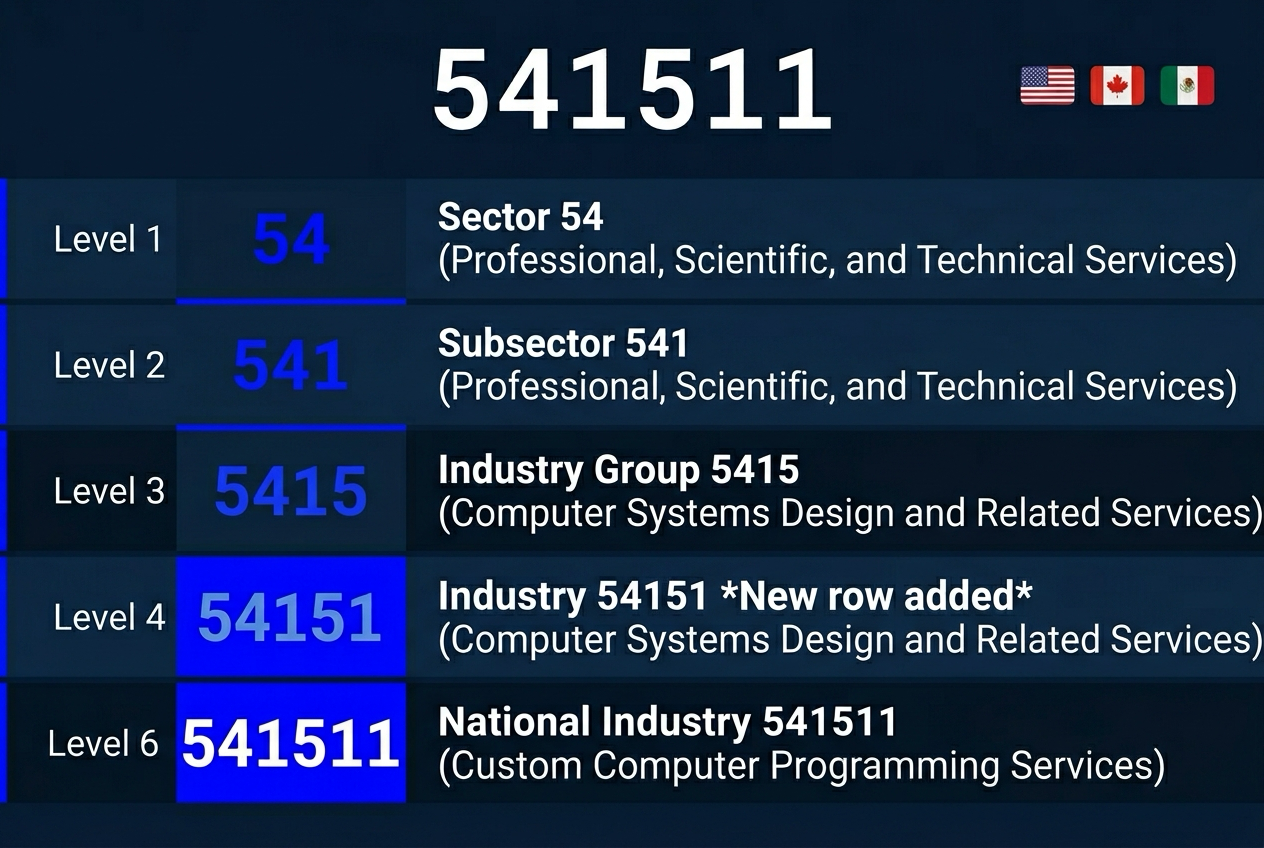
- The hierarchy runs five levels: Sector (2 digits) → Subsector (3) → Industry Group (4) → Industry (5) → National Industry (6).
- A company's primary NAICS code reflects its dominant activity; secondary codes cover additional lines of business.
- NAICS codes are required for U.S. federal contracting (SAM.gov) and are used by the Census Bureau, Bureau of Labor Statistics, and IRS.
- NAICS is revised every five years — the current version is NAICS 2022 — ensuring ongoing coverage of emerging industries.
Every time a company registers for a U.S. federal contract, files with a statistical agency, or appears in a North American B2B database, it is assigned a NAICS code. These codes are the backbone of how governments, researchers, and businesses classify economic activity across North America — yet many people who encounter them regularly have never taken the time to understand exactly how they work.
This guide covers the full picture: what NAICS codes are and what they are not, how the system is structured, how to read a code digit by digit, how primary codes are assigned to companies with multiple activities, and how to find or verify your own NAICS code.
What a NAICS Code Is — and What It Is Not
A NAICS code — North American Industry Classification System code — is a numeric code that classifies a business based on the primary economic activity it performs. It answers one question: what industry does this company operate in?
What a NAICS code is not:
- It is not a unique company identifier. Thousands of businesses share the same NAICS code. It classifies an industry, not a specific company.
- It is not a tax ID or registration number. Having a NAICS code does not constitute formal registration with any government authority.
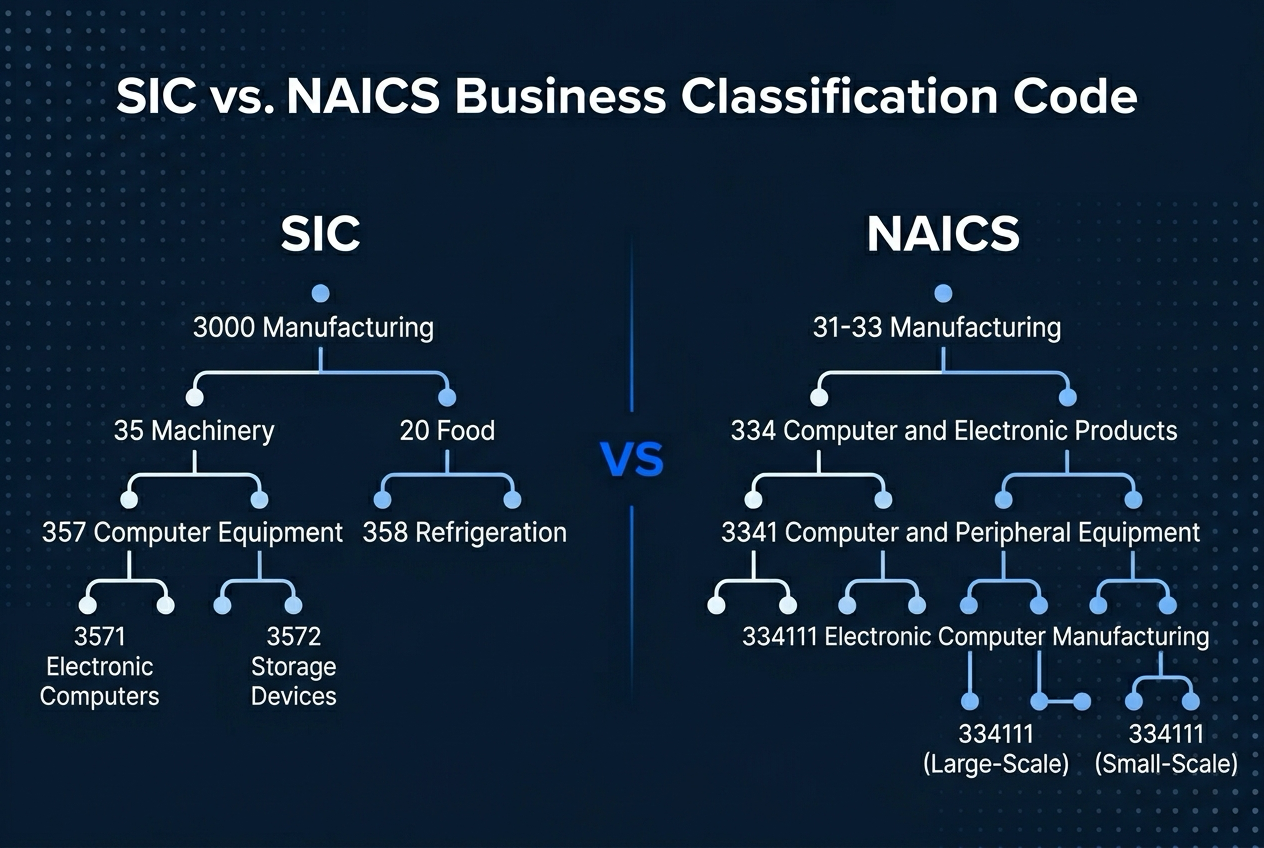
- It is not the same as a SIC codes (the US legacy system). NAICS replaced SIC for most U.S. federal purposes in 1997, but the two systems use different structures, different code ranges, and different sector definitions. The SEC, for example, still classifies public companies by SIC — not NAICS. See our SIC vs NAICS comparison for the side-by-side.
- It is not a European NACE code. NACE codes (the European equivalent) are the EU's equivalent classification system. While NAICS was designed to be broadly compatible with the United Nations' ISIC standard, NACE and NAICS are separate systems maintained by different bodies and are not directly interchangeable.
NAICS codes describe an industry category. They are classification labels, not identifiers or credentials.
NAICS Structure: From Sector to National Industry
The NAICS system is built as a five-level hierarchy. Each additional digit narrows the classification from a broad economic sector down to a specific national industry.
The five levels
Level 1 — Sector (2 digits) The broadest grouping. NAICS divides the entire North American economy into 20 sectors, each identified by a two-digit code.
| Sector | Description |
|---|---|
| 11 | Agriculture, Forestry, Fishing and Hunting |
| 21 | Mining, Quarrying, and Oil and Gas Extraction |
| 22 | Utilities |
| 23 | Construction |
| 31–33 | Manufacturing |
| 42 | Wholesale Trade |
| 44–45 | Retail Trade |
| 48–49 | Transportation and Warehousing |
| 51 | Information |
| 52 | Finance and Insurance |
| 53 | Real Estate and Rental and Leasing |
| 54 | Professional, Scientific, and Technical Services |
| 55 | Management of Companies and Enterprises |
| 56 | Administrative and Support and Waste Management Services |
| 61 | Educational Services |
| 62 | Health Care and Social Assistance |
| 71 | Arts, Entertainment, and Recreation |
| 72 | Accommodation and Food Services |
| 81 | Other Services (except Public Administration) |
| 92 | Public Administration |
Sector
11
Description
Agriculture, Forestry, Fishing and Hunting
Sector
21
Description
Mining, Quarrying, and Oil and Gas Extraction
Sector
22
Description
Utilities
Sector
23
Description
Construction
Sector
31–33
Description
Manufacturing
Sector
42
Description
Wholesale Trade
Sector
44–45
Description
Retail Trade
Sector
48–49
Description
Transportation and Warehousing
Sector
51
Description
Information
Sector
52
Description
Finance and Insurance
Sector
53
Description
Real Estate and Rental and Leasing
Sector
54
Description
Professional, Scientific, and Technical Services
Sector
55
Description
Management of Companies and Enterprises
Sector
56
Description
Administrative and Support and Waste Management Services
Sector
61
Description
Educational Services
Sector
62
Description
Health Care and Social Assistance
Sector
71
Description
Arts, Entertainment, and Recreation
Sector
72
Description
Accommodation and Food Services
Sector
81
Description
Other Services (except Public Administration)
Sector
92
Description
Public Administration
Level 2 — Subsector (3 digits) The first three digits identify the subsector within a sector. Within Sector 54 (Professional, Scientific, and Technical Services), subsector 541 covers Professional and Technical Services as a whole.
Level 3 — Industry Group (4 digits) Four digits narrow to an industry group. Code 5415 identifies Computer Systems Design and Related Services within subsector 541.
Level 4 — NAICS Industry (5 digits) Five digits identify a specific industry. Code 54151 covers Computer Systems Design Services.
Level 5 — National Industry (6 digits) The sixth digit is country-specific. The U.S., Canada, and Mexico share the first five digits but may use different sixth digits to reflect national distinctions. Code 541511 is Custom Computer Programming Services in the United States.
This structure gives NAICS codes their flexibility: the first five digits are comparable across the entire North American economic area, while the sixth digit allows each country to tailor the classification to its own industrial reality.
How to Read a NAICS Code
Each digit in a NAICS code carries specific meaning within the hierarchy. Here is a full walkthrough of two examples.
Example 1: NAICS code 541511
| Digits | Level | Meaning |
|---|---|---|
| 54 | Sector | Professional, Scientific, and Technical Services |
| 541 | Subsector | Professional and Technical Services |
| 5415 | Industry Group | Computer Systems Design and Related Services |
| 54151 | NAICS Industry | Computer Systems Design Services |
| 541511 | National Industry | Custom Computer Programming Services (U.S.) |
Digits
54
Level
Sector
Meaning
Professional, Scientific, and Technical Services
Digits
541
Level
Subsector
Meaning
Professional and Technical Services
Digits
5415
Level
Industry Group
Meaning
Computer Systems Design and Related Services
Digits
54151
Level
NAICS Industry
Meaning
Computer Systems Design Services
Digits
541511
Level
National Industry
Meaning
Custom Computer Programming Services (U.S.)
Example 2: NAICS code 722511
| Digits | Level | Meaning |
|---|---|---|
| 72 | Sector | Accommodation and Food Services |
| 722 | Subsector | Food Services and Drinking Places |
| 7225 | Industry Group | Restaurants and Other Eating Places |
| 72251 | NAICS Industry | Full-Service Restaurants |
| 722511 | National Industry | Full-Service Restaurants (U.S.) |
Digits
72
Level
Sector
Meaning
Accommodation and Food Services
Digits
722
Level
Subsector
Meaning
Food Services and Drinking Places
Digits
7225
Level
Industry Group
Meaning
Restaurants and Other Eating Places
Digits
72251
Level
NAICS Industry
Meaning
Full-Service Restaurants
Digits
722511
Level
National Industry
Meaning
Full-Service Restaurants (U.S.)
A useful rule of thumb: even with no reference guide, the two-digit sector code tells you the broad economic area a company belongs to. Codes starting with 52 are financial; 54 is professional services; 72 is hospitality; 62 is healthcare.
What Is an Example of a NAICS Code?
Here are common NAICS codes across a range of industries, shown at the 6-digit national level:
| NAICS Code | Industry |
|---|---|
| 522110 | Commercial Banking |
| 524210 | Insurance Agencies and Brokerages |
| 531210 | Offices of Real Estate Agents and Brokers |
| 541511 | Custom Computer Programming Services |
| 541512 | Computer Systems Design Services |
| 541611 | Administrative Management and General Management Consulting |
| 611110 | Elementary and Secondary Schools |
| 621111 | Offices of Physicians (except Mental Health Specialists) |
| 722511 | Full-Service Restaurants |
| 811111 | General Automotive Repair |
NAICS Code
522110
Industry
Commercial Banking
NAICS Code
524210
Industry
Insurance Agencies and Brokerages
NAICS Code
531210
Industry
Offices of Real Estate Agents and Brokers
NAICS Code
541511
Industry
Custom Computer Programming Services
NAICS Code
541512
Industry
Computer Systems Design Services
NAICS Code
541611
Industry
Administrative Management and General Management Consulting
NAICS Code
611110
Industry
Elementary and Secondary Schools
NAICS Code
621111
Industry
Offices of Physicians (except Mental Health Specialists)
NAICS Code
722511
Industry
Full-Service Restaurants
NAICS Code
811111
Industry
General Automotive Repair
Notice that NAICS codes at the 6-digit level can be very specific. Two companies that both describe themselves as "technology consultants" might carry different 6-digit codes depending on whether they primarily do programming (541511), systems design (541512), or IT consulting (541519). The specificity is one of NAICS's key advantages over the older SIC system.
Primary NAICS Code and Dominant Activity
Most businesses engage in more than one activity. A software firm might also offer training. A manufacturer might operate retail outlets. When a company spans multiple activities, which NAICS code applies?
The dominant activity rule
A company's primary NAICS code reflects the activity that generates the most value — typically measured by revenue, though employment and output are also used. If a company earns 80% of its revenue from software development and 20% from IT consulting, NAICS code 541511 (Custom Computer Programming Services) is the appropriate primary code.
Primary and secondary codes
In practice, companies can hold:
- One primary NAICS code — the code that best describes the principal business activity.
- One or more secondary NAICS codes — codes that capture additional activities, even if those activities are unrelated to the primary one.
Secondary codes matter in B2B databases and procurement systems. A logistics company with secondary codes in warehousing and freight brokerage will appear in searches across all three activities, not just the primary one.
Who assigns NAICS codes?
There is no single centralised authority for private companies:
- Federal contracting (SAM.gov): Businesses self-select their primary NAICS code when registering. The contracting agency may assign a different NAICS code to a specific contract opportunity based on the work being procured.
- Census Bureau: Companies are assigned NAICS codes based on their survey responses, payroll data, and industry descriptions.
- Commercial data providers: B2B platforms derive or verify NAICS codes from registrations, financial filings, and company descriptions. Codes are updated as a company's primary activity changes.
When a business grows into new areas or changes its core activity, the primary NAICS code should be updated to reflect current operations.
What Is a NAICS Code Used For?
NAICS codes serve a range of purposes across government agencies, commercial markets, and compliance programs.
Federal contracting and procurement
This is one of the most common reasons businesses need a NAICS code. Every procurement opportunity posted on SAM.gov (the U.S. federal contracting portal) is tagged with a NAICS code that describes the type of work being solicited. Businesses register their primary NAICS code in SAM.gov when they set up their entity profile — and only companies with a matching or relevant NAICS code are typically expected to bid.
Each NAICS code in federal contracting also comes with a size standard — a revenue or employee threshold that determines whether a business qualifies as a "small business" for that particular contract. The same company might be classified as small under one NAICS code and large under another.
Federal statistics and economic reporting
The Census Bureau, Bureau of Labor Statistics, and IRS all use NAICS codes as the primary framework for collecting and publishing economic data. The Economic Census, occupational employment surveys, and industry-level tax statistics are all organized around NAICS. This makes NAICS the de facto language for U.S. economic analysis.
B2B marketing and prospecting
NAICS codes are one of the most reliable filters for building industry-targeted prospect lists. Sales and marketing teams use them to:
- Filter company databases to a specific industry or sub-industry
- Build account-based marketing (ABM) audiences segmented by sector
- Identify all businesses in a target vertical, including those in adjacent NAICS categories
- Append NAICS codes to existing CRM records for richer segmentation
The 6-digit specificity of NAICS means that a company selling ERP software to mid-size manufacturers can filter directly to the relevant Manufacturing subsectors (31–33) and drill to specific industry groups — rather than sorting through all industrial companies manually.
State licensing and regulatory compliance
Many U.S. states use NAICS codes in business licensing applications, environmental permits, and workforce programs. Knowing your NAICS code before applying for state-level licenses can simplify the process and ensure you are applying under the correct regulatory category.
KYB and risk assessment
Know Your Business (KYB) programs use NAICS codes as part of industry risk profiling during onboarding. Compliance teams cross-reference a company's declared NAICS code against registry data to verify that stated activities match actual operations. Industries with higher inherent risk — such as money services, cannabis, or high-cash retail — carry NAICS codes that may automatically trigger enhanced due diligence requirements.
NAICS History and Continuity Value
Why NAICS was created
The Standard Industrial Classification (SIC) system served U.S. industry classification from 1937 until the late 1990s. By then, its limitations were clear: it struggled to classify the growing service economy, poorly represented technology businesses, and provided no common standard across U.S., Canadian, and Mexican trade data — a major gap as NAFTA deepened economic integration across North America.
In 1997, the statistical agencies of all three NAFTA countries — the U.S. Census Bureau, Statistics Canada, and Mexico's INEGI — jointly introduced NAICS as a unified replacement. The system was designed to be broadly compatible with the United Nations' International Standard Industrial Classification (ISIC), making North American data easier to compare with global economic statistics.
For a detailed comparison of how NAICS differs from its predecessor, see our guide: SIC vs NAICS: Key Differences, History, and How to Use Both.
The five-year revision cycle
Unlike SIC, which was revised infrequently and eventually stagnated, NAICS follows a structured five-year revision cycle aligned with the U.S. Economic Census. Revisions were issued in 2002, 2007, 2012, 2017, and 2022. Each revision incorporates new industries, eliminates obsolete categories, and adjusts definitions to reflect changes in how the economy actually operates.
NAICS 2022, the current version, includes updates across multiple sectors — notably in information technology, healthcare, and professional services — ensuring that the classification system keeps pace with the businesses it describes.
The coexistence with SIC
NAICS replaced SIC for federal statistical purposes, but it did not eliminate SIC from the business landscape. The SEC never migrated to NAICS and still classifies public companies by SIC code on EDGAR. Many commercial B2B databases maintain both SIC and NAICS codes per company record to support the broadest possible range of downstream uses. If you work with company data at scale, you will encounter both systems — knowing how they relate is a practical advantage.
How to Find or Get Your NAICS Code
Finding your code using official resources
U.S. Census Bureau NAICS search: The Census Bureau maintains the official NAICS manual and a keyword search tool at its website. Enter a description of your primary business activity (for example, "accounting services" or "freight transportation") and the tool will return matching codes with definitions. This is the most authoritative starting point for U.S. businesses.
SAM.gov: If your company is registered or registering for federal contracts, SAM.gov walks you through selecting your primary NAICS code during entity registration. You can also search for NAICS codes directly within the platform.
SBA size standards tool: The U.S. Small Business Administration publishes size standards by NAICS code. If you are assessing small business eligibility for a specific contract, this tool also confirms the correct NAICS code for that procurement category.
Finding NAICS codes for other companies
Commercial data providers: B2B data platforms — including InfobelPRO — include verified NAICS codes in company records, derived from registrations, financial filings, and industry descriptions. Our firmographic data with NAICS codes ships every record with both NAICS and SIC attached, which is the fastest path when you need codes for large batches of prospect companies. If you need to map between systems instead of pulling fresh records, our NACE to SIC converter translates codes across SIC, NACE, and NAICS-adjacent categories without manual lookups.
EDGAR (SEC filings): Note that EDGAR uses SIC codes, not NAICS. If you are researching a publicly traded company and want its NAICS code, you will need to either cross-reference using an external database or use the NAICS search tool to identify the correct code based on the company's described activity.
Mapping NAICS to NACE for European markets
If your work spans North America and Europe, you will encounter both NAICS codes and NACE codes. The two systems cover similar economic territory but are not directly interchangeable. The InfobelPRO NACE/SIC code converter maps between SIC, NAICS-adjacent categories, and NACE codes, helping you bridge classification systems without manual cross-referencing. Going the other way, the NAICS to SIC conversion table maps NAICS 2022 at the five-digit industry level back to SIC 1987.
Browse the Full NAICS Hierarchy
You can browse NAICS codes by sector — every subsector, industry group, and 5-digit industry — in the InfobelPRO NAICS Code Database. Each page shows entity counts, descriptions, and links between levels — from broad sectors like Agriculture, Forestry, Fishing and Hunting (NAICS 11) down to specific 5-digit industries. The database covers all 20 NAICS 2022 sectors and 17.7 million classified US business entities.
NAICS vs SIC: Which One Applies to You?
Both NAICS and SIC remain in active use, and which one you need depends on the context.
- Registering for U.S. federal contracts: You need a NAICS code. SIC is not used in SAM.gov.
- Working with SEC filings or EDGAR data: You will encounter SIC codes, not NAICS. The SEC has not adopted NAICS.
- Using B2B company databases: Most major data providers carry both codes per record. You may filter by either depending on your data source and campaign requirements.
- Sizing markets using government data: Census and BLS data are organized by NAICS. Use NAICS codes to find industry-level employment, revenue, and output statistics.
- Working with Canadian or Mexican companies: NAICS shares its first five digits across all three countries, making cross-border analysis straightforward in a way that SIC never supported.
- Working with European companies: NACE codes apply. NAICS is a North American standard and is not used in the EU.
For a full comparison of how the two North American systems differ in structure, history, and day-to-day use, see: SIC vs NAICS: Key Differences, History, and How to Use Both.